If you photograph your negatives on a white lightbox, this one is for you.
Note
Nothing below says you are doing it wrong. I ship a white-light mode myself, and further down I give you the number it costs. But "why would anyone take three exposures instead of one" deserves a straight answer, and the usual one — because it is more accurate — explains nothing.
#What your camera measures on a lightbox
A colour negative carries three dye layers: cyan, magenta and yellow. To convert it you need to know how much of each is present. That is a density measurement, and a density measurement needs two things — a known light, and a way to read each layer on its own.
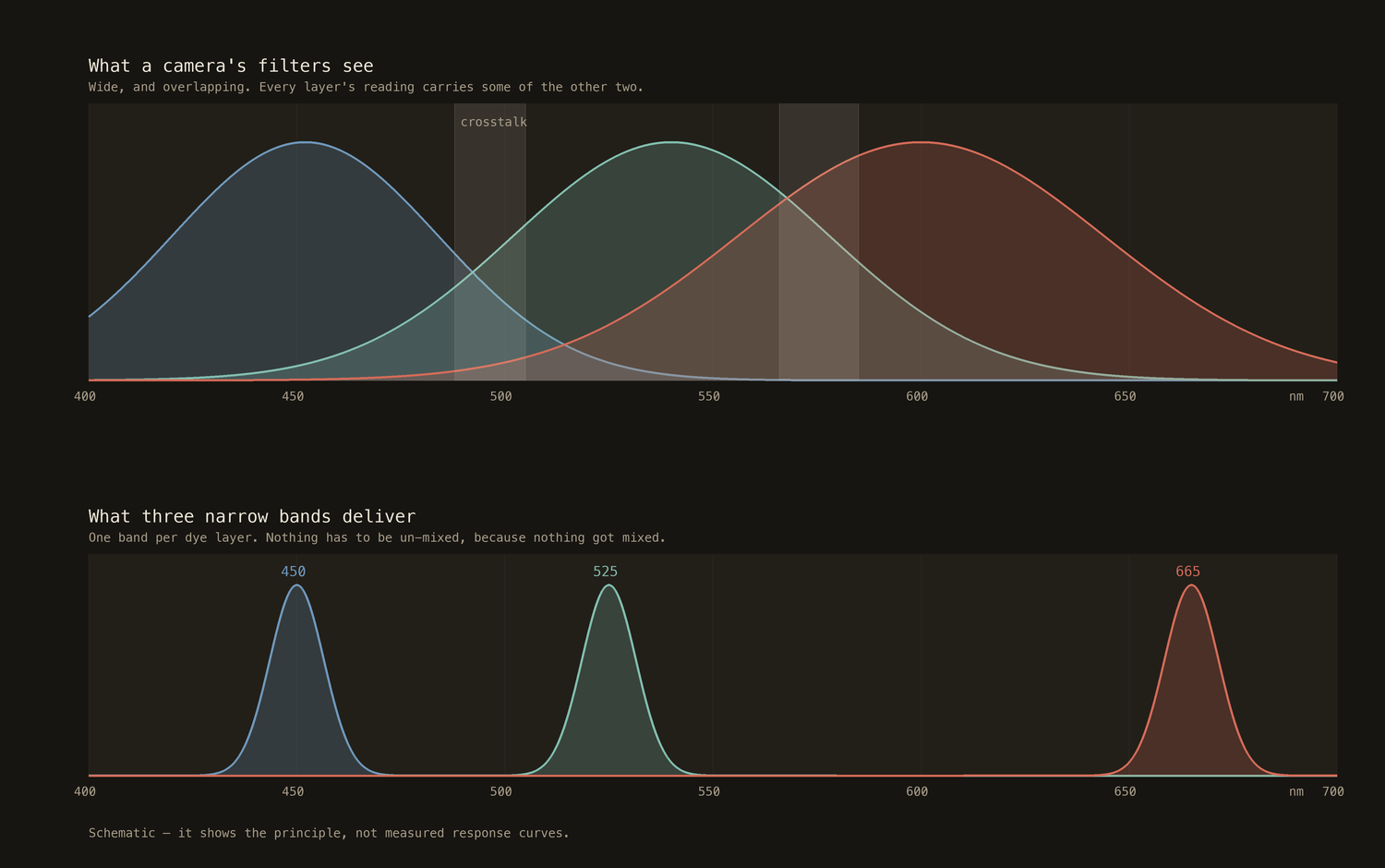
Point a camera at a lightbox and the reading happens through the camera's own red, green and blue filters. Those filters are wide, and they overlap. Your red channel sees part of what the magenta dye is doing. Your green channel sees part of the cyan. Each layer's measurement arrives with some of the other two mixed into it.
That is not a fault in your camera. It is what a camera is for. It was built to see the world roughly the way an eye does, not to isolate three dyes from each other.
#The mask under everything
Then there is the orange base. It sits under the whole frame, it is not perfectly even, and a large share of what reaches your sensor is base rather than picture.
So your conversion software receives a signal in which the three layers are mixed together and the mask is baked in, and it has to pull all of that apart afterwards. This is why single-capture conversions so often want a nudge on every frame, and why two frames off the same roll can land in different places. The software is not being stupid. It was handed an under-determined problem and asked to guess well.
#What one narrow band changes
Light the negative with a single narrow band instead — 665 nm, deep red — and take one exposure. Now almost the only thing modulating that light is the cyan dye. Do it again at 525 nm for magenta, and at 450 nm for yellow.
You now have three measurements that are already nearly independent. Nothing has to be un-mixed, because nothing got mixed. And the mask stops being a puzzle to solve: it becomes a number you measure directly off the rebate, which is unexposed film from that roll, in that developer, on that day.
This is what a minilab scanner does. It is most of the reason a minilab's colour holds still across a roll in a way a one-shot capture struggles to.
#The two paths, side by side
| White light, one shot | Three narrow bands | |
|---|---|---|
| Exposures per frame | 1 | 3 |
| Separating the layers | the camera's own filters — wide, overlapping | one band per dye, nearly independent |
| The orange mask | pulled apart in software, after the fact | measured directly off the rebate |
| Film base | cannot be measured; you name the emulsion | measured, per roll |
| Alignment | nothing to align | sub-pixel registration, or you get fringing |
| Hardware you need | a lightbox | a three-band lamp |
| Cost, measured | about 5 counts a channel | — |
#What it costs you
The honest list:
- Three exposures per frame instead of one — three times the shutter actuations, three times the storage.
- Three shots of the empty gate per session. Density is a ratio; without knowing what the bare light measures, the numbers have no absolute scale at all.
- Registration. Three separate captures of one frame, and nothing on a copy stand is perfectly still. They have to be aligned to a fraction of a pixel before they are recombined, or you get colour fringing on every edge.
- A lamp with three narrow bands, which you cannot walk into a shop and buy.
That last one is the real obstacle, and I would rather say so than talk around it.
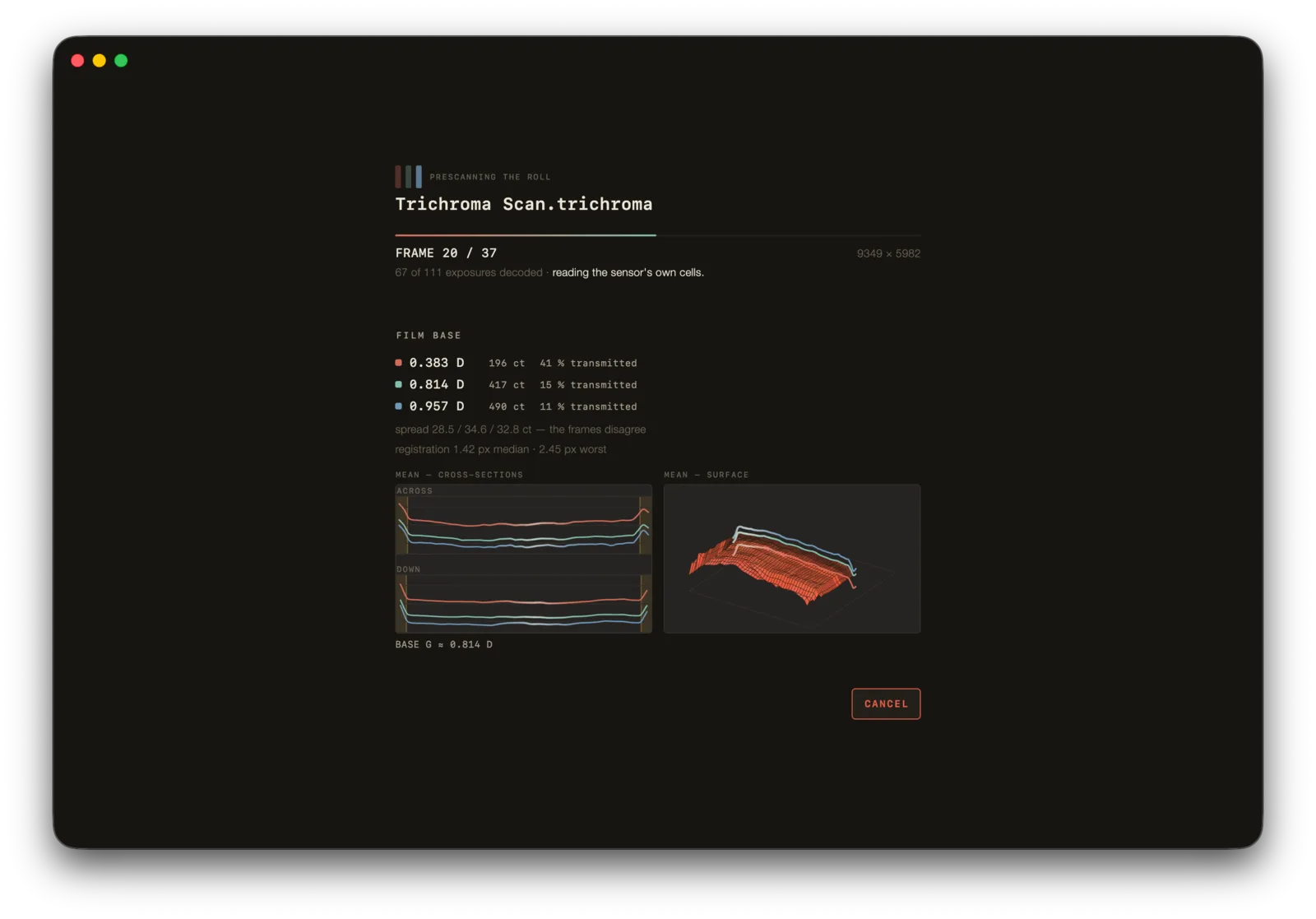
That screen is the denominator and the alignment, both of which the third exposure buys you.
#The number
I fit a white-light path anyway, because most people own a lightbox and almost nobody owns an RGB lamp. The un-mixing is twelve numbers — three rows of four — fitted at one station, on frames photographed both ways. So it is a measurement of that camera and that lamp, not a guess about yours.
What a single shot still cannot do is measure the film base, because it only ever sees that base through the camera's own filters. So in white-light mode you name the emulsion instead, and the roll's own base tunes that entry to your development batch.
Important
Against three bands, over a full 36-frame roll, the white-light path costs about five counts a channel. That is the price of the convenience — not a different pipeline, and not a different look. Five counts is small. It is also not nothing. Whether it matters depends entirely on what you do with the file afterwards.
#Where the lamp comes from
Every frame on the site was shot under Jack's Scanlight — an open-source narrowband light source, hardware and firmware both published:
https://github.com/jackw01/scanlight
Tip
Trichroma Lab has no connection to that project beyond being a grateful user of it. If you build one, or you already have some other three-band source, please say so in Rigs: calibration is per station, and I would like to work yours out with you.
Questions welcome below. And if you scan on a lightbox and something above does not match what you actually see, that is worth hearing too — I would rather find out here than be quietly wrong.